
The Tampa Bay Buccaneers stunned the Dallas Cowboys 24-16 on Thursday Night Football, handing undrafted rookie quarterback Jalon Daniels his first career win — and while the upset dominated the highlight reels, it is also a timely reminder that game day does not have to derail your health goals. The Bucs piled up 241 rushing yards and forced three second-half takeaways to secure their first victory of the 2026 season, dropping the Cowboys to 2-3. If you spent the evening glued to the action with a plate of fried wings and a bowl of queso, here is how to bring the same energy to your next watch party — and your weekly fitness routine — without the calorie blowout.
How the Buccaneers Toppled the Cowboys: Inside the Upset
Jalon Daniels, making just his second NFL start, completed 19 of 25 passes for 189 yards and a touchdown while adding 23 yards on the ground. His 5-yard scoring strike to running back Bucky Irving capped a methodical 15-play drive that set the tone for Tampa Bay's second-half surge at AT&T Stadium. The ground game was the real story, however: the Bucs churned out 241 rushing yards against a Dallas defense that simply had no answer, and they controlled the clock with a lopsided 39:21 to 20:39 edge in time of possession.
ESPN summed it up as a sloppy Cowboys loss and Tampa Bay's first win of the season, while Yahoo Sports pointed out that Dallas managed only 16 points — with 51 minutes separating its first touchdown from its next score. The Athletic was even more direct, describing a Buccaneers team that dominated the second half. For Daniels, an undrafted rookie out of Kansas who played his way onto the roster, the night was a career milestone: a steady, turnover-free performance that ignited what had been a stagnant offense.

Healthy Game-Day Snacks That Won't Sack Your Diet
The average football watch party is a minefield of fried food, creamy dips, and salty chips — but a few smart swaps can cut hundreds of calories and a mountain of sodium without sacrificing flavor. Start with air-fryer buffalo cauliflower wings: toss cauliflower florets in whisked egg, coat them in almond flour seasoned with garlic powder, paprika, and salt, air-fry until crisp, then drench in buffalo sauce. The result is a crunchy, spicy crowd-pleaser with a fraction of the fat of traditional wings and a fraction of the prep time.
Pair the wings with a Greek yogurt ranch dip and a platter of carrot, celery, and bell-pepper sticks instead of sour-cream-based queso. Bake a batch of sweet potato fries, set out air-popped popcorn dusted with Parmesan, and roll up turkey or chicken lettuce wraps for a protein-forward bite. Caprese skewers — cherry tomatoes, fresh mozzarella, and basil drizzled with balsamic — add color and freshness to the table. A little strategy goes a long way, too: eating a small, protein-forward snack before you head to the party, such as a handful of nuts, a hard-boiled egg, or a cup of Greek yogurt, takes the edge off your hunger so you are less likely to graze through the whole spread. Registered dietitians recommend the same playbook for any gathering — lean on whole foods like vegetables, fruit, yogurt, and nuts, and treat chips, candy, and pastries as occasional extras rather than the main event.
How NFL Players Actually Fuel Their Bodies
Ever wonder how the athletes on that field actually eat? NFL nutritionists split players into categories by position. Offensive and defensive linemen — the "bigs" — may take in 4,500 to 7,000 calories a day, and upward of 7,000 during training camp, according to the Atlanta Falcons' performance staff. Skill-position players, by contrast, typically land around 3,500 daily calories. For context, Hall of Fame defensive end J.J. Watt reportedly shaped his diet around as many as 9,000 calories a day at his peak.
A typical wide-receiver fueling plan breaks down to roughly 4-6 grams of carbohydrates per kilogram of body weight, 1.6-2.2 grams of protein per kilogram, and about 1 gram of fat per kilogram — a reminder that even the leanest positions eat far more than the average fan. Protein timing matters as well: sports nutrition guidance for football players emphasizes spreading protein across the day and refueling with a mix of protein and carbs in the window after training. The practical takeaway for the rest of us is simpler than it sounds — build meals around lean protein like chicken, salmon, and lean beef, pair them with quality carbs, and keep anti-inflammatory staples such as turmeric in rotation the way many NFL kitchens do.
Train Like a Pro: NFL-Style Moves for Your Living Room
You do not need a professional locker room to train like the players you just watched. Football-focused programming tends to follow a simple weekly rhythm: three days of strength work (upper body, lower body, and full body), one day of speed and agility, and one day of plyometrics. At home, that might look like box squats and push-up or bench progressions for strength, plus cone drills, ladder drills, and short shuttle runs or sprints for the speed component.
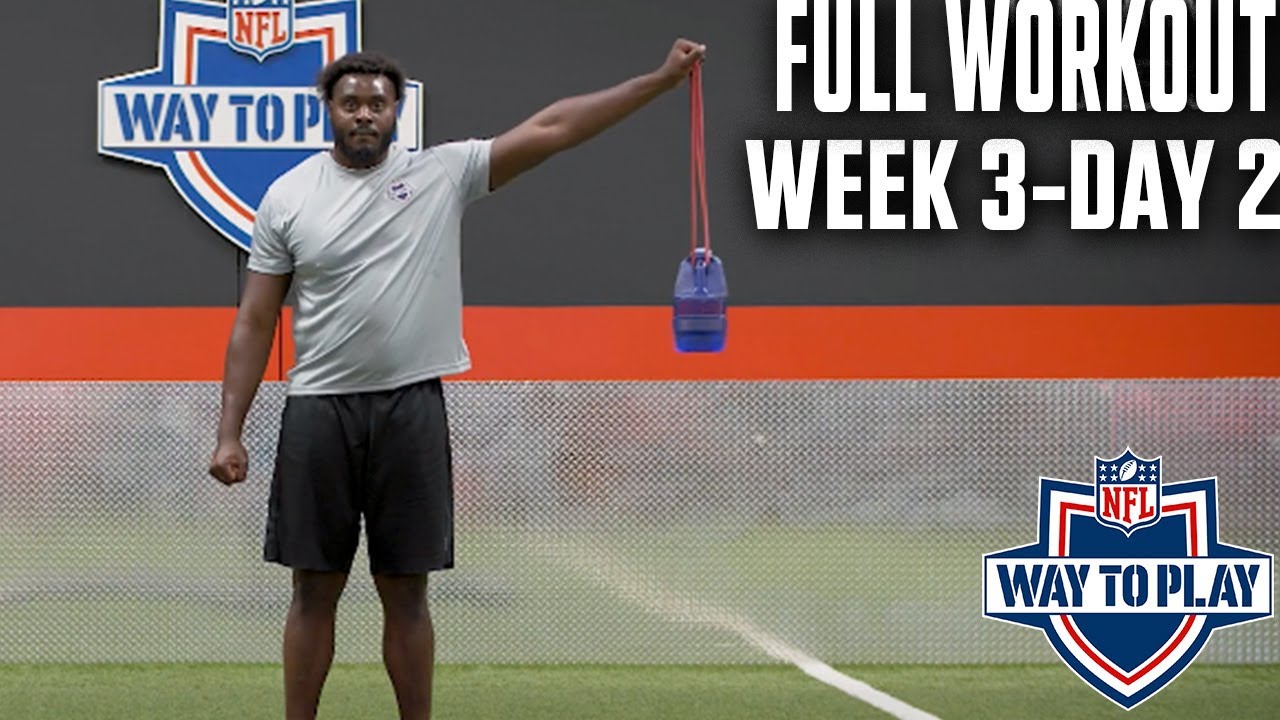
Common speed exercises in a football workout plan include cone drills, ladder drills, shuttle runs, and short, explosive sprints — all of which double as excellent conditioning for anyone looking to add a little athleticism to their routine. Even a 20-minute upper-and-lower-body session using only a resistance band and a water jug can replicate the explosive, multi-joint movements that NFL strength coaches emphasize. Combine two or three of these movements into a 15-minute finisher after a strength session and you have a pro-style training day without leaving the house. The goal is not to bench press a lineman — it is to build the strength, power, and conditioning that carry over to everyday life, from lifting groceries to chasing the kids around the yard.
Where the Bucs and Cowboys Stand Now
With the win, Tampa Bay improves to 1-4 and finally gets off the schneid, while Dallas slips to 2-3 and faces fresh questions about an offense that mustered just 16 points on its home field. Daniels has gone from undrafted afterthought to a legitimate piece of the Buccaneers' quarterback picture behind Baker Mayfield, and his turnover-free night gives the team something to build on. Both clubs now turn their attention to Week 6, looking to carry — or correct — Thursday's momentum.
The Bottom Line: Game-Day Health Takeaways
- The Buccaneers beat the Cowboys 24-16 for their first win, powered by a 241-yard rushing attack and three takeaways.
- Rookie quarterback Jalon Daniels threw for 189 yards and a touchdown in his first career victory.
- Swap fried wings for air-fried buffalo cauliflower and creamy dips for Greek yogurt ranch to cut calories on game day.
- NFL linemen eat 4,500-7,000 calories daily; fans can borrow the lean-protein-plus-quality-carbs framework at a normal calorie level.
- A football-style week — three strength days plus speed and plyometrics — is easy to adapt at home with minimal equipment.