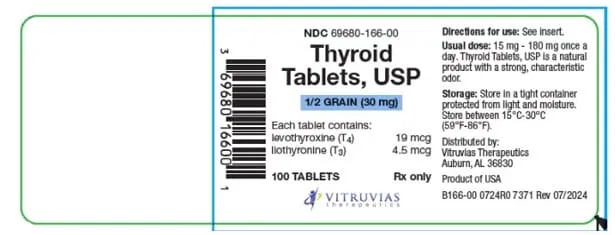
Vitruvias Therapeutics, Inc. is pulling one lot of its Thyroid Tablets, USP 30 mg from the market nationwide after testing confirmed the medication may be superpotent — meaning some pills could deliver more thyroid hormone than the label states. The Auburn, Alabama–based company announced the voluntary recall on August 21, 2026, and the U.S. Food and Drug Administration (FDA) published the company's notice on August 24. The affected product, Lot No. 504950, was distributed to Vitruvias' direct accounts across the country between January 31, 2025 and September 30, 2025. The company has not received any reports of adverse events tied to the recall, but regulators warn that unknowingly taking too much thyroid hormone can trigger symptoms of an overactive thyroid. Here's what thyroid patients and their families need to know.
Inside the Recall: One Lot of Thyroid Tablets, USP 30 mg
Thyroid Tablets, USP is a natural desiccated thyroid medication derived from porcine (pig) thyroid glands. It contains a combination of levothyroxine (T4) and liothyronine (T3) — the two main hormones produced by the thyroid gland — and is prescribed as replacement or supplemental therapy for people with hypothyroidism, or an underactive thyroid.
For the millions of Americans who manage hypothyroidism, daily thyroid replacement keeps metabolism, energy, heart rate, and body temperature in balance. Because the medication is dosed in precise, microgram-level strengths, even a small deviation in potency can matter. In this case, Vitruvias Therapeutics said testing confirmed the potential for the product to be superpotent, meaning some tablets in Lot 504950 may contain a higher dose of active hormone than the 30 mg strength printed on the label.
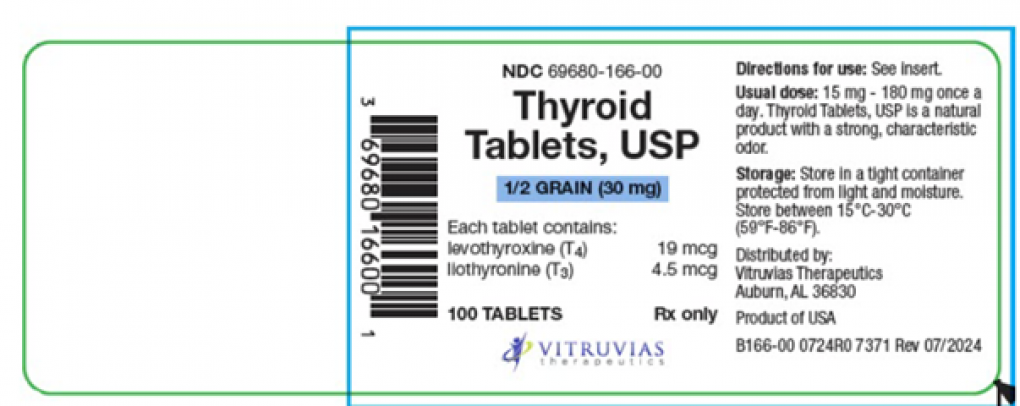
The recalled product can be identified by the following details:
- Product: Thyroid Tablets, USP 30 mg
- NDC: 69680-166-00
- Lot number: 504950
- Expiration date: September 30, 2026
- Units released: 3,655
- Units sold: 1,955
Vitruvias Therapeutics said it is proactively notifying wholesalers by email and phone to discontinue distribution of the recalled product and is arranging for the destruction of all remaining recalled tablets.
Why Superpotency Matters: The Risks of Too Much Thyroid Hormone
Taking a thyroid medication that is stronger than expected can push the body into a state of hyperthyroidism, or overactive thyroid. According to the FDA's risk statement included in the recall, symptoms of consuming superpotent thyroid tablets may include:
- Weight loss
- Heat intolerance
- Fatigue
- Nervousness
- Muscle weakness
- High blood pressure (hypertension)
- Chest pain
- Rapid heart rate or heart rhythm disturbances
The FDA warns that certain groups face a greater risk from superpotent thyroid medication, especially with prolonged use. Excess thyroid hormone in older adults has been associated with adverse outcomes, particularly to cardiac health. In pregnant women, overtreatment of hypothyroidism is linked to a higher rate of maternal and fetal complications, including premature delivery and low birth weight. And in infants, overtreatment may have negative effects on growth and development.
This is why patients should never simply self-correct by skipping doses — suddenly stopping thyroid hormone carries its own risks. Instead, anyone who thinks they may be taking an affected tablet should talk to a healthcare provider about next steps.
Timeline: From Distribution to Recall
The recalled lot was in circulation for roughly eight months before the recall was announced. Here's how the timeline unfolded:
- January 31, 2025: First distribution date for Lot 504950.
- September 30, 2025: Last distribution date for Lot 504950.
- August 21, 2026: Vitruvias Therapeutics announces the voluntary recall.
- August 24, 2026: The FDA publishes the company's recall announcement.
- September 30, 2026: Expiration date printed on the recalled product.
The Bigger Picture: A String of Thyroid Medication Recalls
The Vitruvias recall does not stand alone. ConsumerLab.com noted that the announcement came just weeks after a separate, large recall of levothyroxine tablets distributed by Major Pharmaceuticals — a recall in which the medication was found to be subpotent, the opposite problem, meaning it delivered too little hormone.
Together, the two recalls underscore how sensitive thyroid therapies are to manufacturing consistency. A pill that's too strong can push a patient toward hyperthyroidism, while one that's too weak can leave a patient under-treated and symptomatic in the other direction. For people who rely on daily thyroid replacement to feel well and protect long-term health, potency accuracy is not a minor detail — it's the foundation of safe treatment.
What Patients Should Do Now
If you take Thyroid, USP and your prescription is from Lot 504950, health officials advise against stopping the medication on your own. Abruptly discontinuing thyroid hormone can cause its own complications, so patients should contact their healthcare provider for guidance and, if needed, a replacement prescription.
Consumers with questions about the recall can contact Vitruvias Therapeutics by email at [email protected] or by phone at (256) 239-9373, Monday through Friday from 9 a.m. to 5 p.m. CT. Anyone who has experienced symptoms that may be related to the medication should reach out to a physician or healthcare provider. Adverse reactions or quality problems can also be reported to the FDA's MedWatch program online or by calling 1-800-332-1088.
What's Next
Vitruvias Therapeutics is working to recover and destroy the remaining recalled product through its wholesale network, and the recall is being conducted with the knowledge of the FDA. Patients should check their prescription bottles against the lot number and NDC listed above — a pharmacist can help verify whether a specific bottle is affected. As the recall progresses, additional updates may be posted to the FDA's recalls page, and patients are encouraged to stay in touch with their prescriber about any changes to their medication.
The Bottom Line
- Vitruvias Therapeutics is recalling one lot (Lot 504950) of Thyroid Tablets, USP 30 mg nationwide due to potential superpotency.
- The natural thyroid medication contains levothyroxine (T4) and liothyronine (T3) and is used to treat hypothyroidism.
- Superpotent thyroid can cause hyperthyroidism symptoms such as rapid heart rate, weight loss, nervousness, and high blood pressure.
- Older adults, pregnant women, and infants are at the greatest risk.
- No adverse events have been reported so far, and patients should not stop taking the medication without speaking to a healthcare provider.